RAL-Gütegemeinschaft Kunststoff-Fensterprofilsysteme e.V. (Plastmasas logu profilu kvalitātes asociācija)
Tā ir Vācijas produktu kvalitātes uzturēšanas organizācija, kas apvieno plastmasas logu profilu ražotājus. Šīs asociācijas mērķis ir:
- noteikt un uzraudzīt kvalitātes standartus plastmasas logu profiliem,
- veikt materiālu, izturības un ilgmūžības pārbaudes,
- piešķirt kvalitātes zīmi (“RAL kvalitātes zīme”) ražotājiem, kas atbilst stingriem kritērijiem.
LLDRA ir sagatavojusi ceļvedi, informatīvu materiālu, kas palīdzēs projektētājiem, arhitektiem, logu ražotājiem un māju īpašniekiem labāk saprast krāsainu PVC logu profilu specifiku un aspektus, kas jāņem vērā šādu logu projektēšanā un ekspluatācijā.
LLDRA mērķis ir rūpēties par logu tirgus dalībnieku kompetenci un veicināt aizvien kvalitatīvāku un ilgtspējīgāku risinājumu izmantošanu Latvijas ēkās.
Technical Manual
A Guide for Architects, Designers, and Window Manufacturers
Bonn | Frankfurt, February 2018
1. Purpose of the Manual
Colored window and door profiles are an increasingly popular trend in modern architecture. In the manufacturing process, there would be almost no difference between colored and white surfaces if it were not for the laws of physics. This is because colored surfaces can heat up more under the influence of the sun than white surfaces. Temperatures above 70°C are not uncommon, and given today’s standard levels of thermal insulation, relatively large temperature differences can occur between external and internal surfaces. This, in turn, contributes to undesirable deformation.
In terms of planning and manufacturing, colored window profiles require special attention. To prevent this deformation, we want to outline the specific characteristics of solid-colored window profiles for designers, window manufacturers, or professionals interested in this topic. This manual has been prepared by pro-K Fachgruppen Haustürfüllungen und Kunststofffenstersysteme (pro-K specialist team in the field of PVC window systems) and Gütegemeinschaft Kunststoff-Fensterprofilsysteme e.V. (Quality Association for PVC Window Profile Systems) to pass on the relevant information. It is intended as a useful supplement to industry-standard installation manuals and system supplier requirements, as well as a handy reference to keep on hand from planning to the installation of windows and doors.
Please note that additional literature sources are listed on page 7. A guide with tips on window cleaning issued by Gütegemeinschaft Kunststoff-Fensterprofilsysteme is also available there.
2. Useful Information for Planning
As already mentioned, this guide is primarily intended for designers, manufacturers, and installers of PVC windows and doors. Our recommendations are particularly applicable to the use of the following PVC window profile systems:
- painted and printed
- co-extruded with PMMA, PVC, or other plastic materials
- solid-colored (fully colored)
- laminated with decorative foils
The project manager responsible for planning is in charge of selecting the correct window that matches the structural and architectural conditions. The tender published by the project manager takes into account all parameters relating to the construction product and its integration into the building. This also applies to the choice of color and size of the (window) elements, their positioning, and installation. Ultimately, the project manager must be able to assess how colored surfaces will react to sunlight.
By the way, it should be noted that in accordance with Section 4, Paragraph 3 of Part B of the German Construction Contract Procedures (Vergabe- und Vertragsordnung für Bauleistungen Teil B – VOB/B), the project manager is obliged to inform the client of any concerns that raise doubts about the requested course of action or about actions that are actually already planned within the construction process.
3. Color Selection and Installation Location
When designing colored PVC windows, the material properties and the impact of surface quality must be taken into account. Physically, the increased heat absorption of darker surfaces results in greater thermal expansion of the window profile than is the case with light surfaces. With reference to the system description, the following additional recommendations can be listed:
- Key Parameters: Important factors include window size, reinforcement, the type of window opening (tilt-and-turn windows are recommended in critical installation locations), and, finally, the height-to-width ratio.
- Color Suitability: It is recommended to use colors that are suitable for both the specific installation location and the size of the window.
- Thermal Management: Compensate for thermal stress points with appropriate expansion joints.
- Execution: Ensure professional, expert installation of the window.
Depending on the installation location and the thermal load, certain colors are more suitable for the profile than others. Lighter colors are more favorable in terms of heat accumulation than darker colors, and they are also better suited for complex installation environments. In the case of dark colors, it is recommended to select solutions with heat-reducing properties. By reflecting solar radiation, they minimize heat build-up within the profile.
Even under intense sunlight, the temperature on painted or finished surfaces can remain relatively moderate if natural convection across the building facade provides a cooling effect (see Fig. 1). However, this convection is disrupted by critical installation positions, such as deep external windowsills, deep wall recesses, or verandas. This can lead to extreme heat accumulation in sashes, frames, and front door panels facing south or west without any shading.
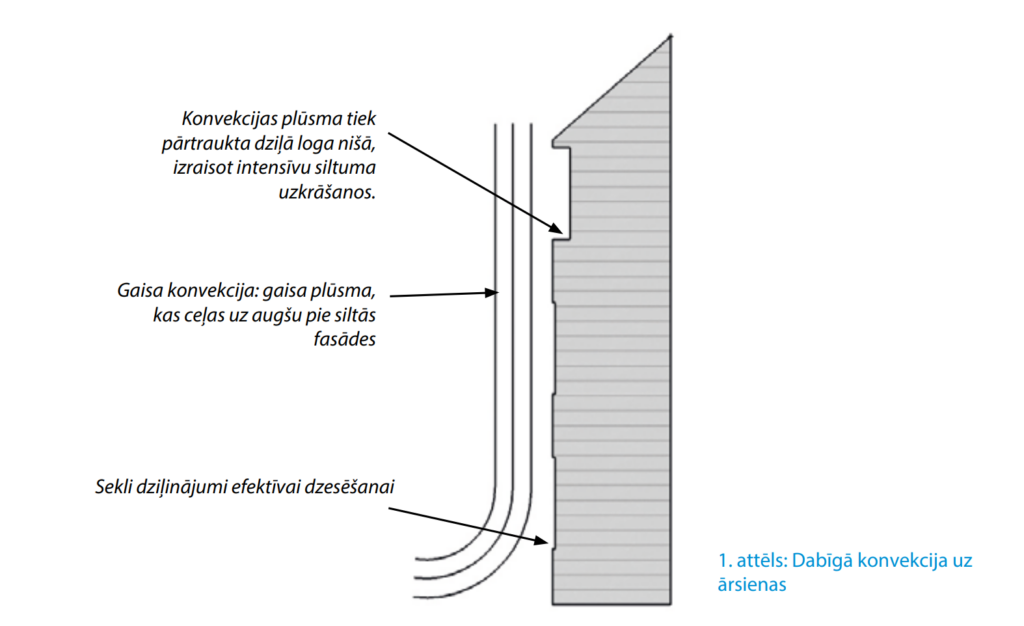
Reflective windowsills or paving slabs intensify this heat effect even further. For example, light-colored windowsills made of natural stone are more suitable.
If you encounter any of the aforementioned critical installation positions, it is highly recommended to develop an individual, custom plan tailored specifically to that critical installation environment.
4. Special Storage and Transportation Conditions
The surfaces of colored PVC profiles are highly sensitive to mechanical damage. Such damage can be impossible or, at the very best, difficult to repair. Furthermore, if PVC profiles and front door panels become deformed during storage or transportation, they will remain permanently warped. Therefore, it is essential to observe a few simple rules:
- Support and Alignment: Profiles and windows must be stored on a completely flat, full-support surface. Front door panels must stand vertically. Both profiles and panels must be stored and transported away from direct sunlight.
- Protective Packaging: As far as possible, use light-colored, opaque packaging film instead of clear or dark wrapping films.
- Heat Dissipation: To prevent heat accumulation, ensure adequate ventilation and leave sufficient space between windows and doors when stacking them sequentially one behind the other.
5. Basic Principles of Colored Window Profile Manufacturing
When selecting and designing colored profiles, several specific considerations must be taken into account—most notably, thermal expansion. These include:
- Outdoor Suitability: Profiles and panels must be fully rated and suitable for their respective outdoor application.
- Structural Connections: All connections linking the profile to the building must be designed as expansion joints.
- Dimensional Variances: Unlike white profiles, dimensional differences occur depending on the thickness of the color layer. In the lamination process, for instance, a thin film layer of approximately 0.25 mm is added.
5.1 Reinforcement and Ventilation
PVC profiles are reinforced to transfer structural loads and prevent deformation. In this regard, it is essential not to weaken this reinforcement when adding extra fasteners and accessories. Ensure, for instance, that drill holes and routings in the steel reinforcements of front door sashes (e.g., for lock cases) are kept as small as possible.
Proper chamber ventilation is also critical for the profiles. If a profile’s ventilation chamber is sealed, the air trapped inside can heat up and expand under solar heat, contributing to uncontrolled profile warping. It is equally important to ensure that windows are not completely covered during or after the installation process, as the air between protective films/sheets and the windows can become extremely hot.
5.2 Profile Welding and Corner Cleaning
A precise profile cut (angle) is vital to ensure rigid joints that withstand thermal stress. Because colored profiles experience greater longitudinal expansion, they place a distinct load on the corner joints. If the weld seam is grooved too deeply or notched, the risk of joint failure at the corners increases. Therefore, sharp notches must be avoided when cleaning these sensitive corners.
Our advice to manufacturers and installers: Regularly test corner strength during the window production process. Additional information can be found in the RAL-GZ 716 quality assurance guidelines and the corner strength tests required by this RAL publication. Guidelines for hot-joint welding are also available on the quality association’s website: gkfp.de
5.3 Hardware Selection
If the system supplier offers multiple hardware configurations, we recommend selecting one with the smallest possible distance between locking points, thereby inherently increasing the total number of locking points. As you know, more locking points ensure better sash fixation.
The specified rebate clearance dimensions must be strictly maintained to allow colored profiles sufficient room for thermal movement. Another indicator of profile deformation is an increase in the force required to operate and close the window after it has been left in a tilted position for a relatively long period.
5.4 Installation of Decorative Surface-Mounted Glazing Bars (Georgian Bars)
When using decorative glazing bars, it is crucial that they are not fitted tightly against the window profile. Linear expansion is effectively accommodated by incorporating expansion joints at least 0.5 to 1.0 mm wide relative to the main profile. For decorative glazing bars equipped with lateral seals, it is best to glue the seals together at the joints.
5.5 Front Door Panels
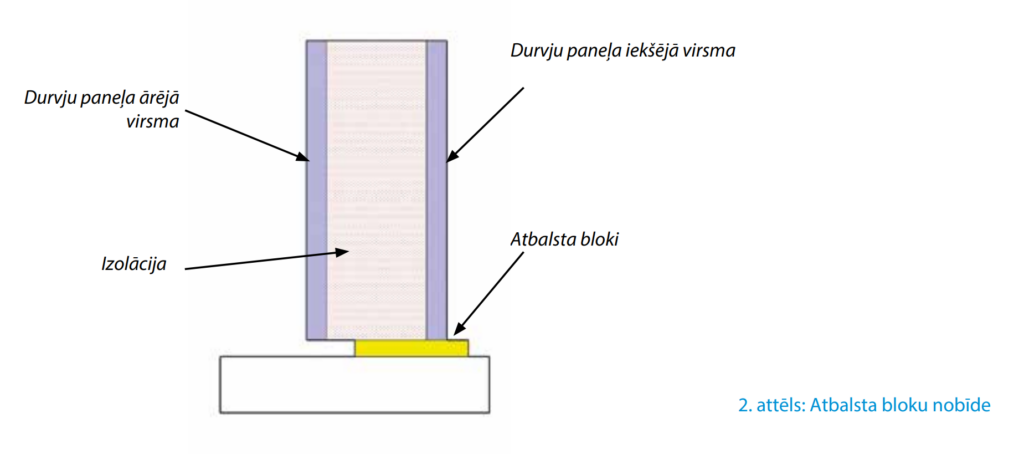
The same thermal expansion laws apply to PVC doors as to PVC windows; therefore, it is essential to ensure the necessary clearance from the building structure during installation. Consequently, the perimeter expansion gap—meaning the distance from the masonry—must be large enough to allow for movement.
If extreme thermal loads are anticipated, it is recommended to stagger the setting blocks (see Fig. 2). This provides greater freedom of movement for the outer load-bearing layer, thereby reducing the risk of deformation. In this regard, the clearance provided by grooves or ridges in the glazing rebate area is equally important. Finally, verify the installation position, paying close attention to sash drainage and ventilation.
6. Tips for the Installation of Colored Windows and Doors
These tips will help ensure a correct process when installing colored PVC windows:
- Windowsill Selection: Choose white, light-colored anodized, or natural stone windowsills to avoid additional heat accumulation, especially when installing dark-colored windows.
- Element Coupling: Use an expansion joint when connecting multiple elements together.
- Perimeter Joints: Provide a larger expansion joint when installing laminated windows into a masonry wall.
- Structural Additions: Avoid the installation of additional profiles and accessories as much as possible.
- Opening Direction: Choose inward-opening doors instead of outward-opening doors.
- Geometric Considerations: Keep in mind that doors with round arches can be subject to distinct deformation.
7. Acceptable and Unacceptable Deformation
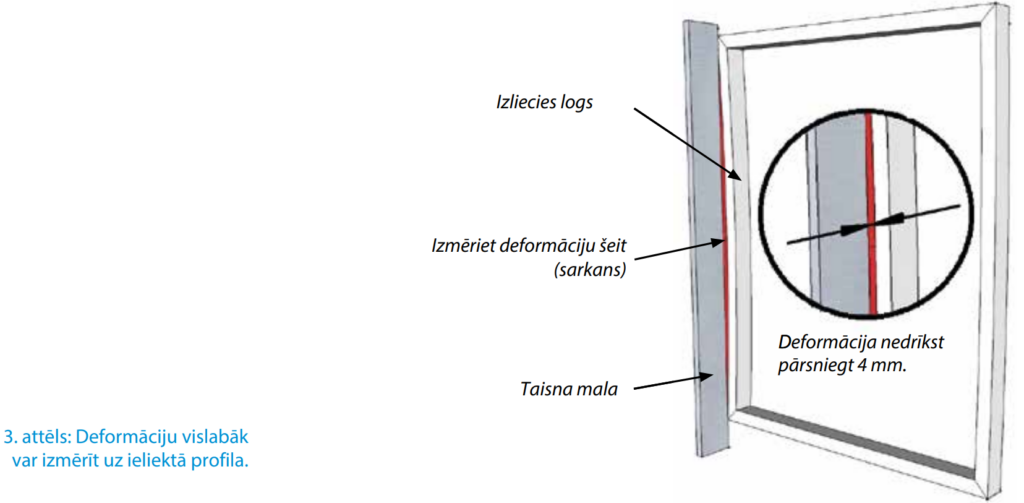
Colored windows and doors can change shape temporarily or permanently due to the temperature difference between the inner and outer surfaces. This may simply be a visual defect, but in more serious cases, it can negatively impact functionality.
Deformation is acceptable as long as performance regarding airtightness and water tightness is maintained. In addition, operational functionality must be guaranteed, which is characterized by a handle operating force of $\le 10\text{ Nm}$ for tilt-and-turn hardware. This can be modified by adjusting the hardware and, if necessary, replacing the strike plates. In practice, it has been proven that windows and front doors function correctly if the deformation is $\le 4\text{ mm}$. In individual cases, the deformation can be even greater than $4\text{ mm}$, provided it does not constitute a defect and operational functionality is guaranteed.
If you wish to measure the deformation, place a straight edge against the outer points of the profile on the concave side (see Fig. 3). To calculate the deflection, take the maximum deviation of the window from the straight line indicated by the straight edge as a basis.
8. Additional Information
- Manufacturing and Installation Instructions – System Supplier Directory:gkfp.de/produktkompass
- Technical Manual on Welding:gkfp.de/ueber-die-guetegemeinschaft/publikationen
- Fact Sheets Prepared by the Pro-K Specialist Groups:pro-kunststoff.de
- IVD Bulletins – Bulletin No. 9: “Perimeter Joints for Windows and Exterior Doors” (IVD hermētiķu asociācijas izdotā brošūra Nr. 9 par logu un ārdurvju perimetra savienojumiem):abdichten.de/ivd-merkblaetter
- Information Bulletins KU.01 – “Visual Assessment of the Surfaces of Plastic Window and Door Elements” and TBV.01 – “Thermal and Moisture-Induced Deformations in Window, Door, and Facade Structures” (brošūras KU.01 par plastmasas logu un durvju elementu virsmu vizuālo novērtējumu un TBV.01 par termiskām un mitruma izraisītām deformācijām logu, durvju un fasāžu konstrukcijās), published by Verband für Fenster- und Fassadenhersteller e.V., Frankfurt:window.de/merkblaetter/
- “Guide to the Design and Installation of Windows and Front Doors in Newbuild and Renovation Projects” (Logu un durvju projektēšana un uzstādīšana jaunbūvēs un renovācijas projektos):window.de/Der-Leitfaden-zur-Montage.327.0.html
- TRLV – Technical Rules for the Use of Glazing with Linear Supports, published by the German Institute for Building Technology (Vācijas Būvniecības tehnoloģiju institūta (DIBt) tehniskie noteikumi par līnijveida nostiprinātu stiklojumu izmantošanu / Deutsches Institut für Bautechnik):dibt.de/en/service/data/eTRLV.pdf
- VOB/B – German Committee for Construction Contract Procedures; Construction Contract Procedures; Part B: General Conditions of Contract Relating to the Execution of Construction Work (2016 Issue) (Vācijas būvniecības līgumu slēgšanas un izpildes komiteja; Būvniecības līgumu slēgšanas un izpildes noteikumi; B daļa: Vispārējie līguma nosacījumi būvdarbu izpildei (2016. gada redakcija)):
Published in cooperation with:
RAL Gütegemeinschaft Kunststoff-Fensterprofilsysteme e.V.
info@gkfp.de
www.gkfp.de/en