Digital Skills Training Project for the Construction Industry and Related Sectors
Project No. 2.3.1.2.i.0/2/23/A/CFLA/003

Virtual Reality as an Occupational Safety Training Method for a Safer and More Efficient Work Environment
From February 24 to 28 of this year, the Vidzeme Innovation Week took place, where the Vidzeme Planning Region annually highlights a theme related to innovation development to spark new ideas in both the public administration and business sectors. This year’s theme is daring—the driving force behind innovation and scientific development.
As part of the Vidzeme Innovation Week, an event titled “Virtual Reality as an Occupational Safety Training Method” was held. It was led by Linda Šlēziņa, manager of the ENGINE project and implementer of the virtual reality (VR) training method at Valmiera Technical School.
Valmiera Technical School has begun introducing VR simulations as an occupational safety training method. VR simulations are gradually being integrated into various vocational education programs, such as construction, logistics, metalworking, and renewable energy. In total, 23 simulations are available covering various topics, including fire safety, electrical safety, safe work with electric vehicles, hand injury prevention, and others.
During the event, anyone interested had the opportunity to try out VR and test their skills and knowledge in one of the simulations. This type of event was particularly suitable for occupational safety specialists, representatives of educational institutions, entrepreneurs, and anyone interested in the latest technologies within the learning process. Representatives from Valmiera Technical School shared their experience and knowledge regarding the application of VR in education and occupational safety. Furthermore, companies and educational institutions had the opportunity to learn about collaboration possibilities and how VR technology can be introduced within a company as a training method.
Source: innovation.vidzeme.lv
Boosting productivity in construction through digital skills is the key to future success!
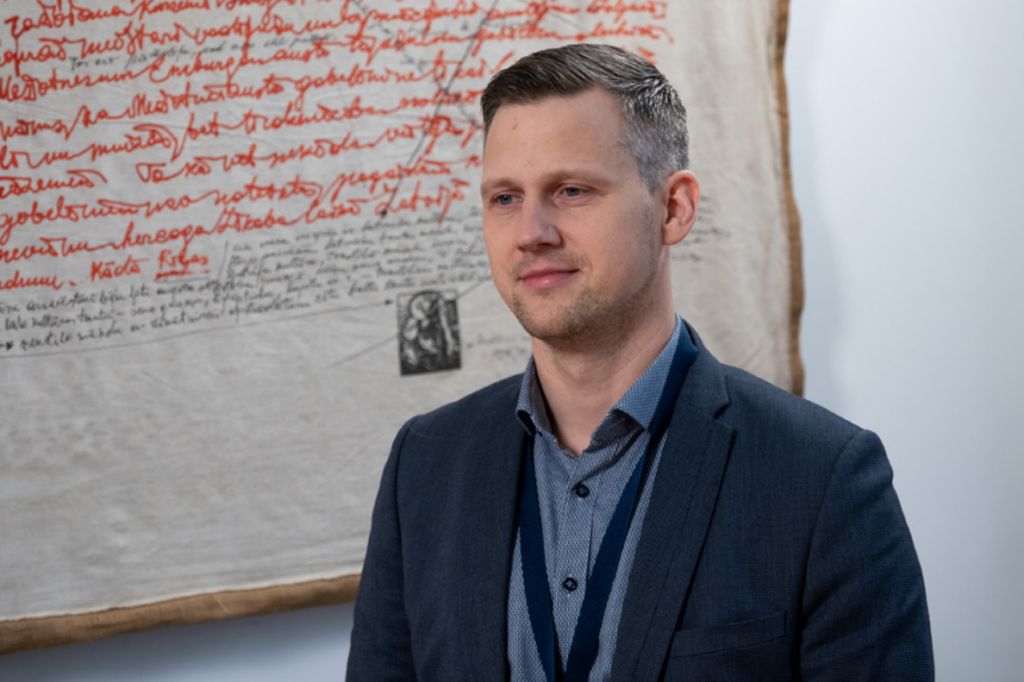 Interview features: Jurģis Kalniņš SIA “Rietumu būvvadība” Business Development Manager, Co-owner
What is the specialization of SIA “Rietumu būvvadība” in the construction industry?
I am Jurģis Kalniņš, representing SIA “Rietumu būvvadība,” and we work on two types of projects. One is restoration and reconstruction in the old town of Kuldīga. The other is new construction—industrial-type production plants. We often act as a partner for various construction companies that are growing and developing; we help them adapt spaces or build new production facilities, because their development begins with construction.
Why is it important for those working in the construction industry to continuously learn?
Because we see that the world is changing, and this necessity is also dictated by the needs of our clients—their production facilities are becoming increasingly complex, and efficiency and productivity are important to them as well. In order for us to be able to build their facilities, especially since many international partners—manufacturers and suppliers—are often involved, we also have to keep up with the times. If manufacturers and suppliers from the world’s leading companies keep coming here, and a builder in Latvia is unable to construct such a production facility, then investments will not flow here either.
What competencies are most important at the management level in the construction industry?
This is a complex question because the construction industry is highly volatile! The foundation would be planning, continuous development, and decision-making. Decision-making is probably the most crucial, as construction changes constantly; right now there is a downturn, and it needs to be overcome across the entire sector. At the same time, the world is changing as well—we must be prepared for new projects and challenges, because when the economy and the sector recover, we won’t be catching the same train, we will be jumping into the next one, which is why development must not stop either.
How are information technologies being introduced in the construction industry, and why is it important to master them?
I see that information technologies in construction are being introduced step by step. There is a project where the builder and the client apply a technology, see what works and what doesn’t, and then in the next project, the requirements increase, and that is how we advance further and further. This mostly stems from client needs; these are very rarely formal requirements, but at the moment we are building a facility, we see that the complexity is so high that BIM and modern technologies are necessary, especially since those involved are often international companies. We cannot do things the old way—with a paper project and on-site construction meetings. Nowadays, construction meetings usually do not take place in person, and most of those involved do not even show up at the site at all.
A good example is SIA “UPB Nams,” which has been doing this for nearly 20 years, so they are far ahead in this technological development, and therefore they are the ones who have introduced a lot of construction information technology in the Latvian construction sector.
What is your vision for the future development of the construction industry?
Challenging! Labor availability is becoming increasingly low; the construction industry is currently shrinking all over Europe, and capacity is falling. When the economy recovers, we will have to be able to build everything our clients want, but if we cannot, there is a risk of the sector overheating, projects might not get built, and we could lose our domestic market share to foreign companies. To accomplish the large volume that awaits us in the future with the existing resource, there is only one way—and that is boosting productivity!
On January 23, the Centre for Educational Research and Innovation (CERI) of the Organisation for Economic Co-operation and Development (OECD) published the report “Trends Shaping Education 2025”, which reflects global trends in education: “Advanced technologies, including artificial intelligence, the Internet of Things, and virtual reality, are already changing how we work, learn, and communicate. While there are many concerns about job displacement, data privacy, equity, and mental health, the goal of these technologies to promote well-being and transform fields as diverse as agriculture, transport, medicine, and culture is driving investment and innovation.”
Source: www.oecd.org
INFORMATION REGARDING ONE OF THE COURSES AVAILABLE IN THE PROJECT
Automated Production Accounting in ERP
LECTURER: Ilze Čerevko
TRAINING COURSE CONTENT:
- Product cards and technological routing sheets;
- Batch tracking and inventory management;
- Costing and prime cost calculation;
- Manufactured product analysis;
- Production planning.
SOFTWARE CONFIGURATION
LATVIAN ASSOCIATION OF WINDOW AND DOOR MANUFACTURERS
Offers the training project
“Digital Skills Training Project for the Construction Industry and Related Sectors”
Project No. 2.3.1.2.i.0/2/23/A/CFLA/003
Project implementation until June 30, 2026
Applications for new training within the project are open until April 30, 2026
Please apply by sending an information request to the e-mail: apmacibas@lldra.lv
The objective of the project’s investment is to provide micro, small, medium, and large enterprises registered in the Republic of Latvia with basic digital, robotization, and automation skills, digital transformation, and digital innovations. This includes skills that facilitate export promotion, basic high-level digital governance skills at the corporate management level, and skills for utilizing digital technologies in various business processes.
The project is implemented with the financial support of the European Union Recovery Fund.
The initial total eligible costs of the project are EUR 1,134,000, including the planned Recovery Fund support of EUR 567,000.
The views and opinions expressed in this publication are solely those of the author(s) and do not necessarily reflect those of the European Union or the European Commission. Neither the European Union nor the European Commission can be held responsible for them.