Digital Skills Training Project for the Construction Industry and Related Sectors
Project No. 2.3.1.2.i.0/2/23/A/CFLA/003

DIGI SPĒKS Conference: Digital Skills Development in the Construction Industry
Last December, the large-scale DIGI SPĒKS conference took place in Kuldīga. It provided practical insights into digital skills development within construction sector businesses, and was enriched by the participation of representatives from the ICT, tourism, light industry, and wood processing sectors, including entrepreneurs, experts, industry leaders, and other interested parties. The main organizer of the conference was the Ventspils High Technology Park Foundation.
During the conference, company representatives and industry experts shared their experiences and success stories on achieving results through the use of digital skills. It also served as an opportunity to network, form collaborations, and meet many inspiring people in one place. Presentations on digitalization were delivered by: Gvido Grīnbergs (Ventspils High Technology Park Foundation), Pauls Siliņš (RigaTechGirls), Kaspars Rožkalns (SIA “UPB Nams”), Jurģis Kalniņš (SIA “Rietumu būvvadība”), Marija Gordina (MG Digital Fashion Studio), Aleksandrs Bobrovs (SIA “Trempel”), Olavs Rāciņš (Delulu Solutions), Antra Meike (SIA “Hotel Virkas muiža”), Sintija Pusaudze (Liepāja Tourism Information Office), Edgars Makarovs (SIA “Kurekss”), Sandis Fogelmanis (SIA “Stiga RM”), Kristaps Freimanis (SIA “TestDevLab”), and Agate Ambulte (Digital Innovation Park).
Ilze Lore, Director of the Business Support Department at the Ministry of Economics, informed conference participants about the available financial support for business digitalization, training courses, and opportunities to receive funding from EU support programs. The main conclusion—digital skills are no longer just a future necessity, but a reality of today. The competitiveness and efficiency of modern enterprises directly depend on their ability to adapt to the digital environment. Digitalization is a continuous process that requires flexibility, curiosity, and a willingness to learn.
Source: vatp.lv
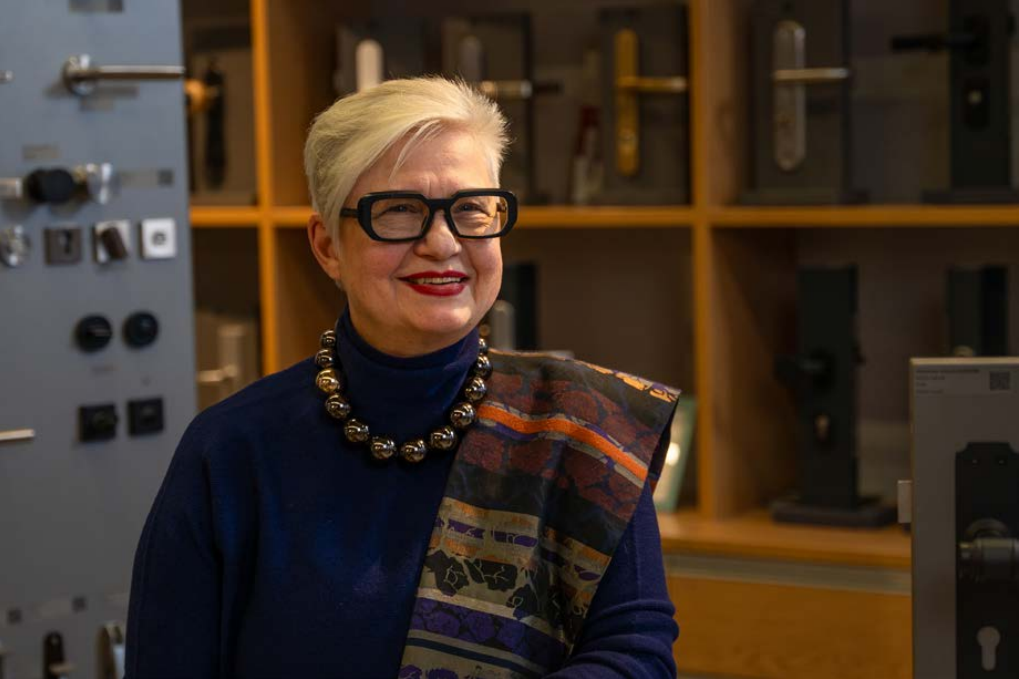 Interview features: Sabīne Beca SIA “SB UN PARTNERI” Founder, Member of the Board
The Success Story of SB UN PARTNERI – Digitalization Multiplies Company Performance and Reaches Key Goals
What is the role of SB UN PARTNERI in the construction industry?
The company SB UN PARTNERI was founded in 1994, 30 years ago. We focus on window and door hardware, which we were already importing from Germany back then. We supply Latvian door and window manufacturers and joinery workshops, as well as advise architects, end consumers, builders, and anyone looking for such solutions. Our mission: we are a systemic supplier that delivers quality products and solutions. We also provide detailed information on how to integrate these solutions; blueprints and descriptions are available on our website, which is highly essential for professionals. Furthermore, we believe it is crucial to provide this information specifically in Latvian, which is why we translate all detailed information. This raises the competence of our carpenters, window, and door manufacturers, enabling them to conquer markets outside of Latvia.
Why is it important for those working in the construction industry to continuously learn?
Continuous development takes place in any industry and reality changes, which is why one must know how to adapt and find solutions to all challenges. Legislative conditions, markets, client desires and demands, the environment around us, problems, and their solutions are all changing. It is necessary to keep up with all these changes. Learning is especially important now, considering that the shortage of specialized labor is a problem not only in Latvia but across all of Europe. We must learn to see how technology can replace manual labor.
What competencies are most important at the management level?
Being open to these challenges! It is important for a manager with broad interests to look for ways to solve the challenges we face. Especially in the field of digitalization—it is vital that the management itself and company owners understand the opportunities provided by new technologies and digitalization: where and how to learn, which processes can be automated, eased, or improved, and how to ensure transparency and digital project management. Employees need to see that management understands and can find solutions, as well as secure financing for them, since digital solution expenses already account for at least a third of total company expenses. It is not enough to just buy a software package; you have to finance its updates and perform data maintenance. Data is valuable if the programs are good, and all of this requires funding! It is important for managers to understand this trend. If a manager is knowledgeable, the company atmosphere becomes favorable, transparent, and relaxed, making it possible to build successful partnerships between employees and management, attracting motivated people who feel that their work and opinions bring a fruitful contribution to the company. The greatest motivation for people is to feel a sense of belonging, which step by step fosters feedback from the employee.
Additionally, it is important for managers to visit international exhibitions in Europe organized by field specialists in Germany. For example, there is the FENSTERBAU FRONTALE exhibition in Nuremberg or BAU—the world’s leading exhibition for architecture, building materials, and systems in Munich. Exhibitions are also held elsewhere—in Poland, Turkey, Italy, and France. In these exhibitions, managers, technologists, and other employees can observe various trends in the industry.
How are information technologies being introduced in the company, and why is it important to master them?
The digital experience of SB UN PARTNERI is extensive, as an accounting system or ERP—which at the time was a localized German program—was introduced in the very year of our founding. Twenty years ago, the website sbunpartneri.lv was created, functioning as a digital catalog where the entire product range is available in Latvian, Russian, and English. This information site gives our carpenters and window/door manufacturers the opportunity to coordinate orders with their clients, and also serves as a marketing tool. Ten years ago, we also created our first e-shop, which we modernized on a new platform last year. It is important to understand that for window and door manufacturers, these tools function as an ordering system where they register, see their specific prices, and view all previous orders, allowing them to place subsequent orders easily, quickly, and correctly. Through digitalization and automation processes, we have been able to ease the workload both for ourselves and our clients, as well as multiply work efficiency and manage workload volumes.
Another challenge expected in the near future is the requirement for e-invoicing between legal entities and government institutions across the European Union (EU). This will be organized strictly digitally from system to system, which will promote lower paper usage and reduce the occurrence of errors. Manufacturers must take this into account because digitalization is required here as well, especially since it will later become a mandatory requirement between legal entities and private individuals.
Starting this spring, we have also been using a task definition and project management platform where all tasks are visible and traceable, keeping employees from different departments informed about monthly processes within the company. Very often, company growth is hindered because employees are not sufficiently informed, so this platform provides an overview of where, to whom, how, when, and what needs to be done.
Another benefit of digitalization is the ability to control the company’s balance sheet, as accountants are able to provide data and the latest figures on a monthly basis. The main task of accounting is not to satisfy the State Revenue Service (VID), but rather the company’s management, reporting with data whether we are on the right track. Digitalization makes it possible to increase company performance with the existing number of employees and their labor, reaching our main goals—to turn a profit and provide quality services to clients who gladly return to us.
How do you see the future development of the industry?
I cannot comment on the broad construction industry as a whole, but regarding the specific niche we operate in—the hardware manufacturing sector that affects window and door manufacturers and joineries—I am convinced that we need a deeper understanding of BIM capabilities, marketing tools, the opportunities provided by artificial intelligence, climate change, cooperation with related companies, communication skills at all levels, proactive work with clients, complaint management, and the potential of websites as a constantly growing information organism. A deep understanding of these processes raises our professionalism and competitiveness in the EU market. We are part of the EU, and a website is a window that opens up opportunities in a vast market. It is not enough to simply take courses on digitalization; company owners and management must maintain a continuous awareness of its evolution, which must be constantly developed.
Anatoly Subocs, an expert from the European Commission’s Recovery and Resilience Facility implementation working group, emphasizes: “Digitalization is the main driving force for the economic growth of the European Union (EU), promoting competitiveness, innovation, and sustainable development. With EU support, Latvia is investing in the development of digital skills and the digital transformation of enterprises, establishing Digital Innovation Hubs and providing training for citizens and businesses.”
Source: vatp.lv
INFORMATION REGARDING ONE OF THE COURSES AVAILABLE IN THE PROJECT
BIM Practitioner
LECTURERS: Agnis Mārtiņš Bērziņš, Māris Besarskis, Andris Vilcāns, Armands Dreijers, Rolands Ancāns, Ēriks Vītols, Aivars Ozoliņš
TRAINING COURSE CONTENT:
- The Role of BIM in Architectural Design Streamlining: Optimizing design workflows and documentation layout.
- BIM Software Fundamentals in ArchiCAD: Core tools, interface navigation, and basic object setup.
- Architectural Modeling Techniques: Best practices for constructing accurate structural and spatial digital elements.
- Tekla Structures Masterclass: Practical insight into 3D modeling and detailed structural engineering design.
- BIM for MEP (Mechanical, Electrical, Plumbing) Design: Coverages for HVAC (AVK), Water Supply/Sewerage (UK), Power Supply (EL), and Electronic Communications Systems (ESS).
- BIM Methodologies for MEP Efficiency: Raising design quality, accuracy, and multidisciplinary coordination.
- BIM Integration with CADMATIC: Specialized engineering approaches for power supply and telecommunications layouts.
- DIALux Import/Export Workflows: Utilizing photometric data, manufacturer product models, and databases for large-scale layout modifications.
- ESS Systems & FAS (UATS) Symbol Deployment: Inserting standardized components and generating functional schematic diagrams.
- HVAC (AVK) and Water/Sewerage (UK) Design: Specific modeling workflows for piping, ductwork, and equipment routing.
- BIM Project Coordination Plans (BEP): Structuring process workflows, managing tasks, and enforcing execution protocols.
- 4D (Time/Scheduling) & 5D (Cost/Estimating) BIM Concepts: Essential terminology, practical implementation benefits, and hands-on skill development.
AUTOMATION AND DIGITALIZATION OF PRODUCTION PROCESSES